The Alphabet
Yiddish is written in the Hebrew alphabet. It has combined some of these letters, and added some diacritics, to better represent the speech sounds of the language. Yiddish is read from right to left (as is Hebrew). In words of more than one syllable, the accent usually falls on the next-to-the-last syllable.
Grammar
The following is a greatly simplified description of some of the basic rules of Yiddish grammar. For serious study, we recommend Uriel Weinreich’s classic text, College Yiddish, published by the YIVO Institute for Jewish Research.
Articles
The Yiddish indefinite article — a, an — is used the same way as the English equivalent. But unlike in English, the Yiddish definite article is distinguished by gender in the singular: der yingl (the boy, masculine); di mame (the mother, feminine); dos kind (the child, neuter). The plural has only one definite article, di, as in di kinder (the children).
Adjectives
Gender is important also in forming adjectives. When modifying a masculine noun, the adjective ending is -er (masculine): a guter fraynd (a good friend); with a feminine noun, the ending is -e: a gute neshome (a good soul); with a neuter noun, the adjective ending is also -e when it is preceded by a definite article; and regardless of gender, the plural ending of an adjective is also -e: di sheyne hayzer (the beautiful houses).
With your help, My Jewish Learning can provide endless opportunities for learning, connection and discovery.
Nouns
Yiddish nouns take chiefly the following plural endings:
-n, -en, as in shuln (schools), nodlen (needles)
-er, as in kinder (children), hayzer (houses)
-s, -es, as in fishers (fishermen), zaydes (grandfathers)
-ekh, as in shtetlekh (towns)
-im, as in khaveyrim (friends)
Verbs
The infinitive of Yiddish verbs has the ending -n or -en, as in essn (to eat), zingen (to sing). The past participle of Yiddish verbs is formed by adding the prefix ge- and the ending -(e)n or -t to the base of the verb. For example, the past participle of kumen (to come), is gekumen, and of nitsn (to use), is genitst. The past tense of verbs is formed by adding the past participle to the auxiliary verbs hobn (to have) or zayn (to be) — for example, ikh hob gezen (I saw, I have seen); zey zaynen (or zenen) gekumen (they came, they have come).
READ: This Sunday School Teaches Jewish Kids Yiddish — and Socialism
READ: These Comedians Want to Bring Yiddish Humor to TV
Yiddish vs. Hebrew
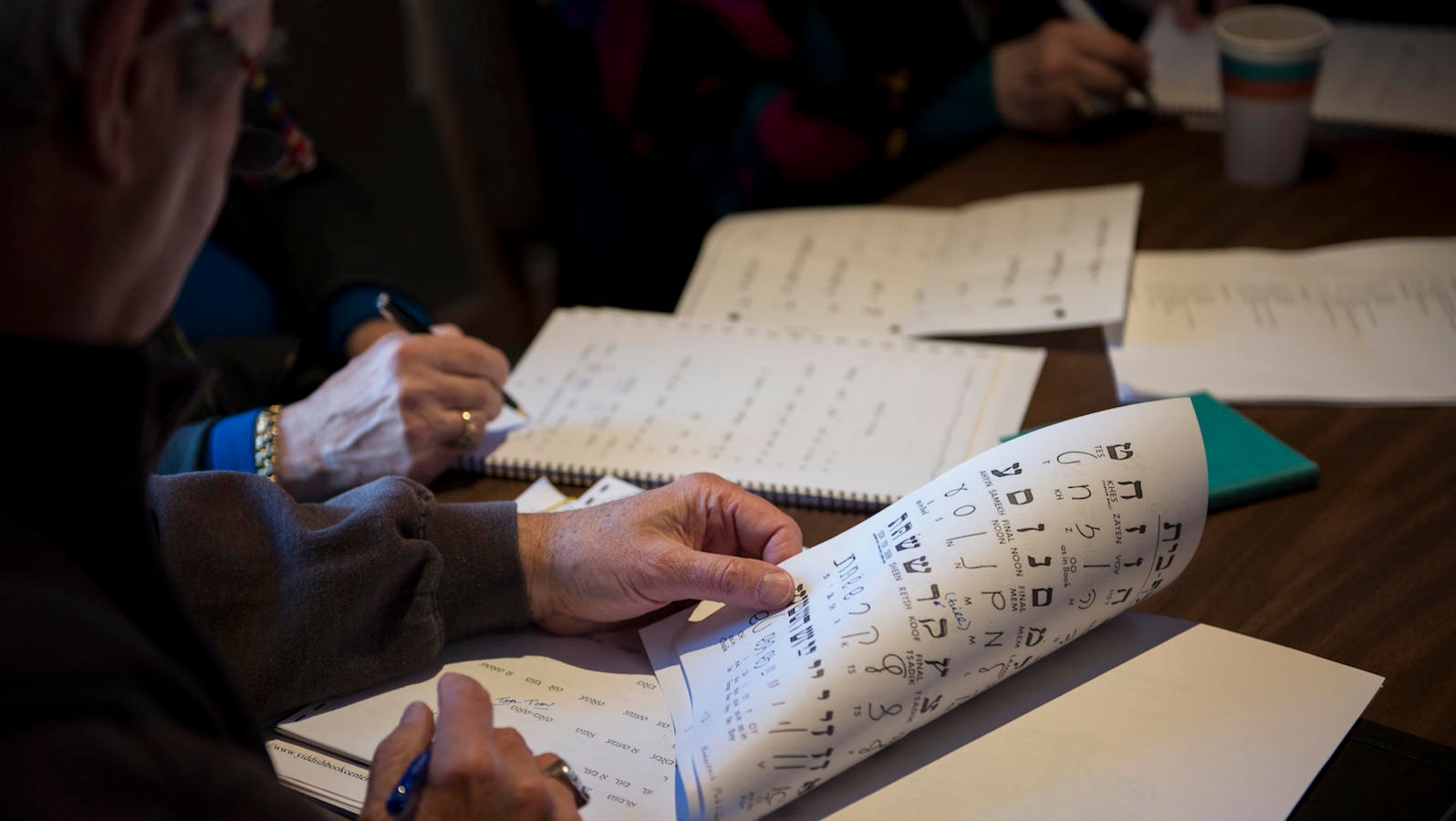
Contrary to what people might think, Yiddish and Hebrew are very different languages. The reason why the two are often linked in people’s minds is that Yiddish speakers have usually learned how to read Hebrew in childhood, since the Bible and Jewish .prayers are written in classical Hebrew. But this form of Hebrew is very different from the modern Hebrew spoken and written in Israel, which few Yiddish speakers speak or understand. The fact is that linguistically Yiddish and Hebrew are as different from one another as Japanese is from Chinese.
The Japanese-Chinese example is actually a close parallel to Yiddish-Hebrew, for this reason: Just as Japanese borrowed from Chinese its system of writing, along with many Chinese words, so Yiddish borrowed its system of writing from Hebrew, as well as many Hebrew words. And just as Japanese and Chinese are two totally different and unrelated languages, so too are Yiddish and Hebrew.
Yiddish-Hebrew Similarities
The few similarities between Yiddish and Hebrew can be summed up as follows:
• Both Yiddish and Hebrew are spoken and written primarily by Jews, and are the most widely spoken Jewish languages in the world.
• The two languages share the same alphabet.
• Both languages are read from right to left.
• Neither language uses capital letters.
• Words shared by both languages (Yiddish having borrowed them from Hebrew) are spelled identically — though their Romanized transcriptions may differ slightly to account for differences in pronunciation. Examples of such words are: Hebrew shalom, Yiddish sholem, both meaning peace; Hebrew yom tov, Yiddish yontev (holiday); Hebrew and Yiddish emes (true); sheker (falsehood). Yiddish has acquired hundreds of such common words from Hebrew.
Yiddish-Hebrew Differences
The most important differences between Yiddish and Hebrew are these:
• Yiddish is a Germanic language, belonging to the Indo-European family of languages, while Hebrew is a Semitic language, belonging to the Afroasiatic family of languages.
• Yiddish is what linguists call a “fusion language,” meaning that it has integrated within its Germanic structure elements from such diverse languages as Hebrew, Aramaic, Old Italian, Old French, Czech, Polish, Ukrainian, and Russian. By contrast, Hebrew consists almost entirely of pure Semitic stock.
• Yiddish is spoken chiefly by Jews of East European (Ashkenazi) origin or descent. Hebrew is spoken chiefly by Israeli Jews or Jews of Middle Eastern origin or descent.
• In Yiddish, words of more than one syllable are generally stressed on the penultimate (or next-to-the-last) syllable. In Hebrew, words of more than one syllable are generally stressed on the last syllable.