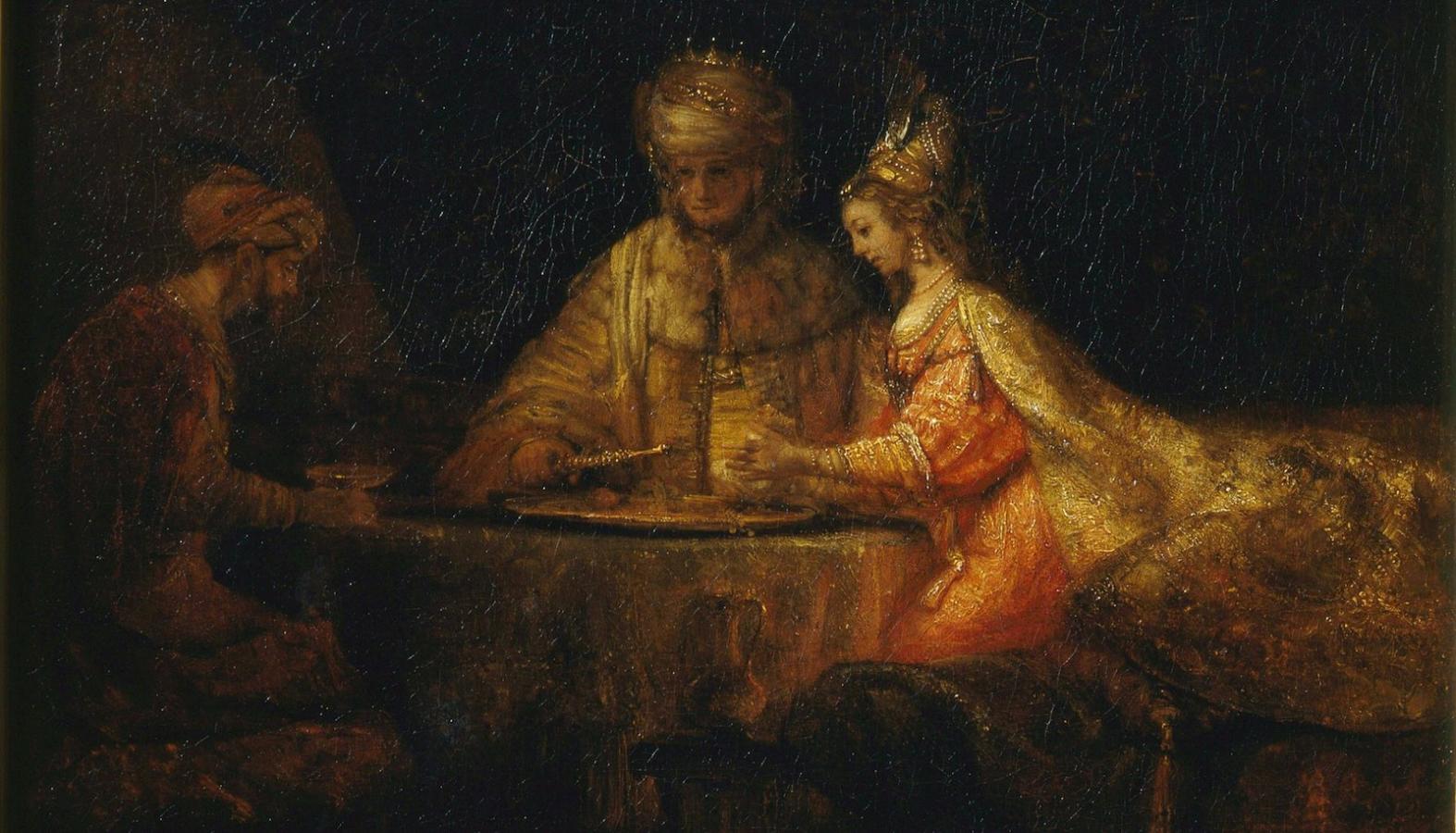
Megillat Esther, The Book of Esther in the form that we have it in the Hebrew Bible, provides the story of the origin of Purim, the blueprint for its celebration, and the authorization for its observance in perpetuity.
For the full text of the Book of Esther in Hebrew and English, click here.
Take a deeper dive into the Book of Esther! Click here to receive a short email series exploring this book.
The story itself is implausible as history and, as many scholars now agree, it is better viewed as imaginative storytelling, not unlike others that circulated in the Persian and Hellenistic periods among Jews of the Land of Israel and of the Diaspora. This story seems to have been known in several different versions, or to have gone through a number of different stages in its development, before it was linked with Purim and incorporated into the Bible.
With your help, My Jewish Learning can provide endless opportunities for learning, connection and discovery.
Diaspora Story
As a Diaspora story — a story about, and presumably for, Jews in the Diaspora during the Persian period — it provides an optimistic picture of Jewish survival and success in a foreign land. In this it resembles other Diaspora stories such as the biblical Book of Daniel (chapters 1-6) and the apocryphal books of Judith and Tobit. But unlike those books, Esther lacks overtly pious characters and does not model a religious lifestyle.

Esther is the most “secular” of the biblical books, making no reference to God’s name, to the Temple, to prayer, or to distinctive Jewish practices such as kashrut [keeping kosher]. Yet Esther, of all the biblical books outside of the Torah, is the only one that addresses the origin of a new festival. For this reason, if for no other, Esther should be considered a “religious” book. Its main concern, the very reason for its existence, is to establish Purim as a Jewish holiday for all generations.
Legitimizing Purim
Megillat Esther establishes the Jewishness of the holiday by providing a “historical” event of Jewish deliverance to be commemorated and an authorization, through the letter of Mordecai, for the continued commemoration of the event. Just as the more ancient festivals are historicized and their observance is mandated by the Torah, so Purim is historicized and its observance is mandated by the Megillah.
The Book of Esther serves as the authorizing document for Purim, a holiday that is not mentioned in the Torah. But the Megillah’s mandate differs from the Torah’s in one crucial respect: It is careful not to say that God commanded the observance of Purim. In fact, God is nowhere mentioned in the book and this absence emphasizes the distinction between the Torah and its festivals on the one hand and the Megillah and its festival on the other. The Megillah makes no suggestion that Purim is an ancient festival that had been forgotten or neglected. Purim is clearly a new festival, of recent origin.
The Megillah gives legitimacy to this first post-Torah festival in a mode that is quasi-traditional but at the same time quite contemporary. Following tradition, the book’s explanation of Purim as a “historical” event to be commemorated harks back to the Torah’s etiologies (stories of origin) for the well-established holidays. But, calling on contemporary practice, the form in which the holiday was instituted imitates the legal practice of Persia. Purim was legislated in much the same way that all Persian law was legislated — by means of a document written by the king or his authorized agent and circulated throughout the empire.
This rhetorical strategy of calling upon both traditional and current forms must have made the etiology of Purim more compelling to ancient readers. In fact, the Book of Esther, more than anything else, is responsible for the continued celebration of Purim. It also opened the way for the establishment of later holidays that, like Purim, could be instituted without divine command if they commemorated an important event or served an important function in the life of the Jewish people.
Serious Theme, Comic Style
Another successful rhetorical strategy is the combination of a serious theme and a comic style. The threat of the destruction of the Jews is no laughing matter, but the Book of Esther is hilariously funny. The raucous Persian court, with its lavish display of luxury and its pervasive drinking parties, is not the setting we expect for the impending annihilation of the Jewish people. The plot glories in revelry and bawdiness (and this may be the primary reason for the absence of God’s name).
The frivolity of the book’s style — with its hyperbole, mockery, and comic misunderstandings and reversals — undercuts the gravity of its theme. Yet, for the Purim festival this setting, plot, and style are natural and fitting, part and parcel of the celebration of Purim. The tone of the book fits its purpose: a comic story for a carnivalesque holiday.
I find in this comic style additional evidence that the purpose of the Megillah was to model and to authenticate the celebration of Purim. In the Greek versions of Esther, which de-emphasize Purim, the comic elements are diminished. The Hebrew Esther and the festival of Purim bring us a uniquely irreverent and joyously optimistic celebration of Jewish identity and Jewish continuity.
Excerpted with permission from The JPS Bible Commentary: Esther published by the Jewish Publication Society.
<!–Adele Berlin is Professor of Hebrew Bible at the University of Maryland. Copyright 2001 by the Jewish Publication Society.
–>
Purim
Pronounced: PUR-im, the Feast of Lots, Origin: Hebrew, a joyous holiday that recounts the saving of the Jews from a threatened massacre during the Persian period.
Torah
Pronunced: TORE-uh, Origin: Hebrew, the Five Books of Moses.


