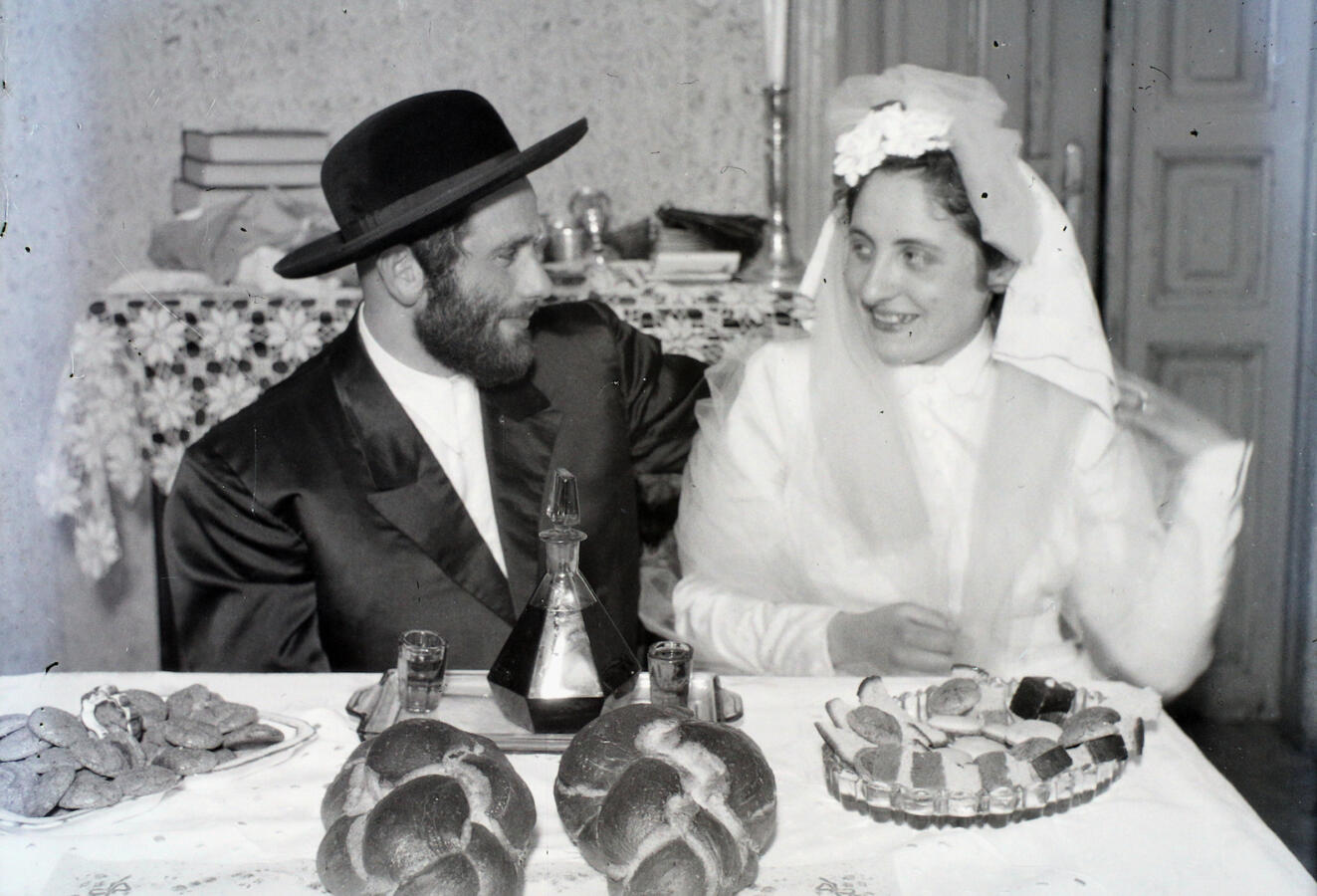
The contemporary Jewish wedding ceremony comprises two ancient ceremonies that used to be separated by about a year–erusin, or betrothal, and nissuin, the actual marriage. Excerpted with permission from Celebration and Renewal: Rites of Passage in Judaism edited by Rela Mintz Geffen (Jewish Publication Society).
Immediately following the reading of the ketubah [the marriage contract], the second ceremony begins. This ceremony involves the recitation of seven blessings and hence is commonly referred to as the Sheva Berakhot. The text of the liturgy is as follows:
The Seven Blessings
1. Praised are You, O Lord our God, King of the Universe, Creator of the fruit of the vine.
2. Praised are You, O Lord our God, King of the Universe, Who created all things for Your glory.
Help us keep Jewish knowledge accessible to millions of people around the world.
Your donation to My Jewish Learning fuels endless journeys of Jewish discovery. With your help, My Jewish Learning can continue to provide nonstop opportunities for learning, connection and growth.
3. Praised are You, O Lord our God, King of the Universe, Creator of man.
4. Praised are You, O Lord our God, King of the Universe, Who created man and woman in Your image, fashioning woman from man as his mate, that together they might perpetuate life. Praised are You, O Lord, Creator of man.
5. May Zion rejoice as her children are restored to her in joy. Praised are You, O Lord, Who causes Zion to rejoice at her children’s return.
6. Grant perfect joy to these loving companions, as You did to the first man and woman in the Garden of Eden. Praised are You, O Lord, who grants the joy of bride and groom.
7. Praised are You, O Lord our God, King of the Universe, who created joy and gladness, bride and groom, mirth, song, delight and rejoicing, love and harmony, peace and companionship. O Lord our God, may there ever be heard in the cities of Judah and in the streets of Jerusalem voices of joy and gladness, voices of bride and groom, the jubilant voices of those joined in marriage under the bridal canopy, the voices of young people feasting and singing. Praised are You, O Lord, Who causes the groom to rejoice with his bride.
After the Blessings Are Recited
During the recitation of these blessings, as was the case in the first ceremony, the rabbi holds a cup of wine aloft. And once again, upon completion of the blessings, groom and bride drink from the cup.
The most striking characteristic of the blessings is that, with the exception of the last one, they focus not on love, but on the theme of creation. In addition to referring to God as “Creator of the fruit of the vine” in the omnipresent blessing over wine, the liturgy refers to God as creator of all things, creator of man, creator of man and woman, and creator of the peace of the Garden of Eden. The theme of creation plays several significant roles in the ceremony. First, it relates to the Jewish conception of marriage as a natural state and suggests that, by marrying, the couple now enters this appropriate condition. Second, it suggests that the marriage furthers God’s process of creation, furthering a project the tradition sees as yet unfulfilled.
Rashi, the classic medieval commentator on the Talmud, offers an alternate explanation for the blessings. He suggests that the second benediction is in honor not of the couple, but of all those assembled at the ceremony. The third is in honor of the creation of Adam. The next three refer specifically to the couple being married. And the last is in honor of all Jews everywhere, including, of course, the couple themselves.
One element of the blessings that cannot be denied is that they refer to grooms and brides, men and women, beyond time. Obviously, one element of this “era beyond time” is the Garden of Eden, cited specifically in the liturgy. But in mentioning creation, the liturgy subtly suggests the tradition’s commitment to the notion of purposeful creation, and alludes to the future era when God’s purpose for humankind will be realized. Jacob Neusner has suggested that the couple represents not only Adam and Eve in the Garden of Eden, but also young men and women in a rebuilt Jerusalem, redeemed in the messianic era. In both representations, the couple exists beyond time and history, in a direct relationship with God and the people Israel.
Repeating the Blessings at the Meal
The seven blessings are repeated once after the ceremony, at the festive meal that follows. There, the grace after meals is recited using one cup of wine, and the Sheva Berakhot using another. Upon completion of the blessings for the second time, the two cups of wine are mixed into a third, and husband and wife now drink from the third cup.
The blessings are then recited every day for the next seven days, as long as at least one person is present at each meal who was not present before. On the Sabbath, the Sabbath Bride “herself ” is considered the new “person.”
Addressing the Couple
If the rabbi speaks at the ceremony, he or she usually does so after the seven blessings [although some rabbis speak after the reading of the ketubah, before the Sheva Berakhot are recited]. But it is not unusual for more than one person to address the couple under the huppah, at any of several points during the ceremony. Some rabbis also elect to offer a separate blessing for the couple, often the tripartite “Priestly Blessing” (Numbers 6:24-26). Such matters are not regulated by tradition.
Breaking the Glass
The next, and final, ritual element of the ceremony is the shattering of a glass. Traditionally, it is the groom who shatters the glass with his foot, though in some more modern communities groom and bride both do so. Most traditional commentators explain this custom as having originated with incidents recorded in the in which Mar, the son of Ravina, and Rav Ashi deliberately smashed costly glass at their sons’ weddings to put a stop to the raucous dancing and celebrating.
Modern explanations have focused on a more solemn theme, claiming that the broken glass reminds Jews assembled at a joyous occasion of the Temples and recalling those individuals, Jew and non-Jew alike, who do not have the freedom to celebrate either religiously or publicly. A more mystical explanation of the ceremony is that the glass represents the couple and that just as the glass, when it is broken, enters a state from which it will never emerge, it is the hope of the community that this couple will never emerge from their married state. Finally, one modern source suggests:
“Beneath its articulated Jewish historical meaning (remembrance of the destruction of the Temple), this act has symbolic sexual-anthropological meaning. It is an obvious representation of the sexual consummation of the marriage by the breaking of the hymen. It also is an act of noisemaking employed to chase away demons that might attack the couple as they pass through that liminal period between unmarried and married status.”
This evaluation of the tradition of breaking the glass is extraordinarily novel. Whether these anthropological factors actually played a role in the origins of the ceremony is difficult to say.