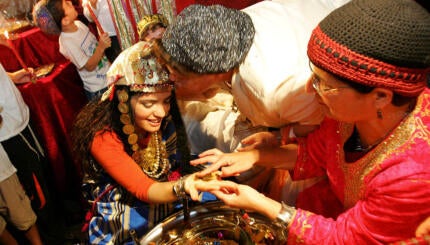
As with many lifecycle and other ritual events in Judaism, community is a vital aspect of marriage, despite the inherently private relationship that a wedding celebrates. In the following article, Rabbi Lamm offers a traditional view of the role of community in marriage. Reprinted from The Jewish Way in Love and Marriage by permission of Jonathan David Publishers.
Marriage is Basic Unit of Jewish Community
The non-Jewish practice of celibacy reflects a philosophy of withdrawal from the real world. Jewish marriage is the decision to confront the challenge of the real world. The Jew, when he marries, enters not only marriage, but the world–the world of the Jewish community, of concern for the survival of the Jewish people, and of care and responsibility for total strangers. As a man-wife unit, the married couple has a new voice.
Historically, the family-oriented Jewish community, which experienced very few divorces and virtually no abandonments, gave little consideration to the opinions of single people. When God became a partner at the wedding, and a new Jewish home was created, an overriding significance was added. In some communities this is still demonstrated by the groom’s donning, for the first time, a tallit (prayer shawl).
The requirement of a minyan at the wedding (the quorum of 10 that is the smallest unit of the Jewish social structure) is an important indication of the social significance of marriage.
With your help, My Jewish Learning can provide endless opportunities for learning, connection and discovery.
Rabbi Joseph Soloveitchik describes how Maimonides differentiates three friendship categories (haver, companion, associations) within marriage. First is haver le’davar, a utilitarian association that depends on reciprocal usefulness. When the usefulness disappears, the bond of "love" dissolves (batel davar, batel ahavah). Second, is haver le’daagah, someone with whom to share sorrows, troubles, and also joys. We need this in order to lighten our load. Joys are multiplied and sorrows are divided when they are shared. Third is haver le’deah, a joint dedication to common goals. Both dream of realizing great ideals, with a readiness to sacrifice for their attainment.
Marriage must at least partake of the first and second friendship levels, the physical and psychological aspects of joint partnership. But if the partners are truly haverim and their union is hibbur (a joint partnership), they form a community of commitment.
Marital Love Creates the Jewish Future
Love seeks eternity, sanctity, rootedness in a transcendent power. True lovers cannot endure in a hastily-put-together arrangement. Love will not be fulfilled until it reaches that ultimate moment, the total commitment of marriage.
Love is a sacred trust. The description of the relationship of bride and groom preserved in the blessing at the wedding service is reim ahuvim (beloved friends).
The secular sanction of a civil marriage is not sufficient to motivate love to rise to its highest level; it needs the sanctification of an almighty and eternal God. Love so desanctified cannot long withstand the daily frustrations, angers, and hurts. To flourish, love needs an intimation that it originates in the plan of the Creator; that the world could not exist without it; and that an all-knowing God delights in it.
Marriage is the natural home of love. Here it can grow and enrich itself, and leave something worthy in its wake. Love that is not able to express itself in the cares of married life is frustrated love. "It is not good that man should be alone," says Rabbi Jacob Zevi Meklenburg, "means that man’s inner capacity for goodness can never be realized unless he has someone upon whom to shower his affections." Mature love is expressed through giving, and through giving comes even greater love.
To have a child is a flesh-and-blood connection with the future, and the birthplace of humanity’s future is the home. The future of the whole Jewish people depends upon marriage, the covenantal relationship of husband and wife. Marriage is not simply a private arrangement designed solely for mutual satisfaction; its importance rests in how the couple perceive their bond, the love they demonstrate, and the constellation of virtues they bring to the home. Every marriage covenant must partake of the original covenant. Jewish values thrive not as ephemeral theories, but as they are lived daily. This means that the Jewish couple needs a religiously-oriented home, an investment in the Jewish community, and a concern with the fate of God’s world.
The eternal Jewish future depends on the old Jewish past, which gives ample evidence that Jews who relate to God survive. The words of the betrothal blessing are important in this context: He forbade relations for the betrothed, and permitted it for the married. These are declarations of God who created man and woman and ordained marriage. Given true love and a man and woman who follow religious and ethical precepts, life holds the possibility of being as close to paradise as is possible in this world. But if they violate God’s commands, they must repeat the experience of Adam and Eve in paradise lost. Judaism teaches that every bride and groom must go back to Adam and Eve, and reenact that physical and spiritual drama of community as "one flesh."
Jewish marriage serves many purposes, but the phrase that incorporates all of these purposes is central to the wedding service: "You are hereby sanctified unto Me… " But the covenant requires more than this declaration of sanctity. It is the remainder of the marriage formula that is crucial to Jewish survival: "… according to the laws of Moses and Israel."